

Which Web Apps for Your Business Website?
You have a professional website for your business in Cambodia or across Southeast Asia. It looks good, it presents your services clearly, and it ranks reasonably well in search results. But is it actually doing much for your visitors – or for you – beyond that? For many small and medium businesses, the answer is not really. This is where web apps come in.
What is a Web App, exactly?
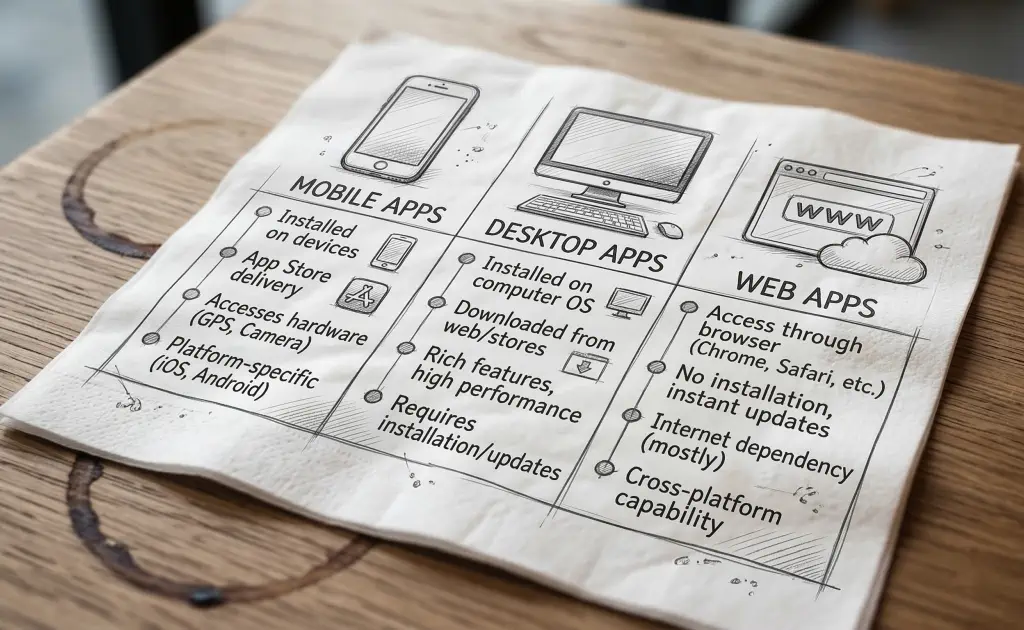
Most people are familiar with mobile apps – the kind you download from the App Store or Google Play – and desktop apps, which you install directly on your computer. A web app is different: it runs entirely through a web browser, with no installation required. You simply visit a URL, and the application works.
Web apps range from very simple tools, like a contact form with automated responses, to complex platforms like Google Docs or Trello. What makes them valuable for business websites is their flexibility: they can be embedded directly into your site, making the experience seamless for your visitors. No redirect to an external platform, no app download, no friction.
Unlike a static page that just displays information, a web app interacts with the user. It takes inputs, processes them, and delivers something back in real time. And unlike a mobile app, it works across all devices – phone, tablet, laptop – without any additional development effort.
How Web Apps fit into a business website
We are not talking here about e-commerce – that is a separate subject. What concerns us is the typical corporate or small business website: a company in Phnom Penh offering legal services, a guesthouse in Siem Reap, a consulting firm in Bangkok, a small manufacturer based in Ho Chi Minh City. These businesses need websites that communicate trust and professionalism, yes – but also websites that actively serve visitors.
A well-chosen web app can transform a passive website into an active business tool. It can qualify leads before they ever reach your inbox, give visitors instant answers at any hour, or automate tasks that your team currently handles manually. The key is choosing apps that match your audience and your actual workflows.
Integration is generally straightforward. Most web apps today are offered as embeddable widgets or iframes, or they connect to your site through a small snippet of JavaScript. A competent web developer can typically add one in a matter of hours, not days.
Five ideas for custom-built Web Apps
The following examples are not off-the-shelf plugins – they are small applications that a developer builds specifically for your business, tailored to your content, your logic, and your users. None of them requires a large budget or a complex technical infrastructure.
-
A Project or Service Estimator
A simple form where a visitor inputs a few parameters – surface area, project type, duration, quantity – and the app instantly returns a ballpark estimate based on your own pricing logic. For a construction company, interior design studio, or freight forwarder, this kind of tool is immediately useful. It does not replace a formal quote, but it qualifies the visitor and saves your team from fielding vague enquiries. The logic lives entirely on your server; you adjust the rates whenever your costs change.
-
An Interactive FAQ or Decision Guide
Rather than a static list of questions and answers, this is a small branching app that guides a visitor toward the right answer based on their situation. A legal firm might build one that helps a visitor understand which type of business registration applies to their case. A clinic might use one to help patients identify which consultation they need. The visitor answers two or three questions and receives a clear, tailored response – along with a prompt to get in touch. The content is fully controlled by the business and can be updated without touching any code.
-
A Real-Time Availability Display
For businesses where availability matters – a guesthouse, a training room rental, a vehicle hire company, a co-working space – a live availability widget embedded in the site tells visitors immediately whether what they need is free on the dates they have in mind. The app connects to a simple back-end database that your staff updates from a private admin panel. No more enquiries for dates that are already taken, and no frustration for the visitor who had to send an email to find out.
-
A Personalised Content Filter
If your business serves several distinct client profiles – for example, an accounting firm that works with both NGOs and private companies, or a school that offers programmes for children, teenagers, and adults – a simple filtering interface lets each visitor self-select and immediately see only what is relevant to them. Rather than scrolling through services that do not apply, the visitor clicks once, and the page reorganises itself around their profile. It is a small interaction, but it significantly reduces the cognitive load for first-time visitors navigating an unfamiliar site.
-
A Document or Certificate Verification Tool
For businesses that issue certificates, licences, membership cards, or official documents – training centres, professional associations, inspection companies – a verification tool lets anyone enter a reference number and instantly confirm that a document is genuine. The visitor types in a code; the app checks it against your database and returns a confirmation or flags it as invalid. This builds trust with third parties who need to verify credentials, and it removes the need for manual verification calls or emails to your office.
Start small, think strategically
You do not need to implement all of these at once. The best approach is to identify the single biggest friction point your visitors currently face – or the most repetitive task your team handles – and address that first. A custom estimator for a logistics company, a verification tool for a training centre, an availability display for a guesthouse: one well-built web app, developed specifically for your business, can deliver measurable results within weeks of going live.
What matters is that your website stops being a digital brochure and starts becoming an active participant in your business. In a competitive market like Southeast Asia, that distinction is increasingly what separates businesses that grow online from those that simply exist there.
The Benefits of Connecting Your Website with Social Media to Boost Your Audience
This article is part of our series on practical website strategy for small businesses, institutions, and corporations.
Your comments are always welcome on our Facebook page, where we share all our articles.